

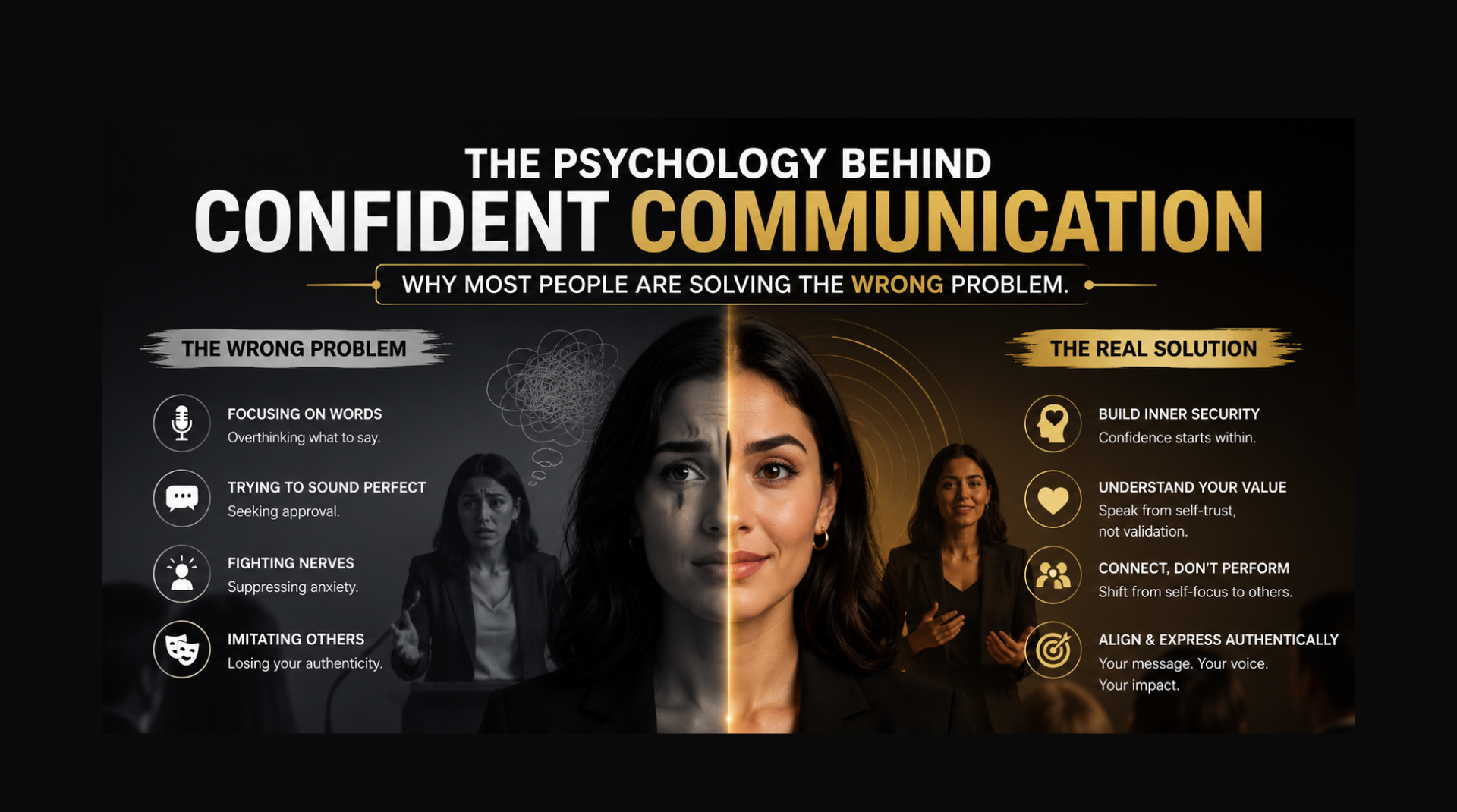
When people tell me they want to become more confident speakers, I usually ask them one question:
“What do you think confidence actually is?”
Most of them pause.
Then they start describing external behaviors:
- Speaking louder
- Making eye contact
- Standing up straight
- Using hand gestures
- Speaking more fluently
These are all valuable skills.
But they’re not where confidence begins.
After coaching hundreds of professionals…from ambitious graduates to managers, entrepreneurs, and executives, I’ve noticed something fascinating:
The biggest communication problem rarely starts when people open their mouths.
It starts much earlier.
It starts in the mind.
Communication Begins Before You Speak
Imagine you’re in a meeting and you have an idea to contribute.
Before you’ve said a single word, your mind starts asking questions.
“What if this doesn’t make sense?”
“What if someone disagrees?”
“Maybe I should wait until I can explain it better.”
“Someone else probably has a stronger point.”
Within seconds, you’ve created an internal conversation that’s louder than the one happening in the room.
By the time you finally decide to speak, you’re no longer communicating your idea.
You’re managing your fear.
This is why many intelligent professionals struggle to communicate with clarity.
You’re Not Bad at Speaking. You’re editing while talking.
One of the most common patterns I see is what I call the Internal Editor.
As you’re speaking, another part of your mind is silently reviewing every sentence.
“That didn’t sound right.”
“Use a better word.”
“You’re talking too fast.”
“You’re losing them.”
“Don’t sound stupid.”
Instead of focusing on your message, your attention is divided between communicating and judging yourself.
That mental split is often what leads to:
- Speaking too quickly
- Rambling
- Losing your train of thought
- Forgetting words you know perfectly well
- Sounding less confident than you actually feel
Ironically, the harder you try to sound impressive, the harder it becomes to communicate naturally.
Why Traditional Communication Advice Falls Short
There’s no shortage of advice telling people to:
- Maintain eye contact.
- Smile more.
- Slow down.
- Use stronger body language.
These techniques can certainly improve delivery.
But if your internal dialogue is still saying, “Don’t mess this up,” you’ll continue fighting yourself every time you speak.
The external behaviors may change.
The internal experience remains the same.
That’s why real transformation requires more than learning communication techniques.
It requires understanding the psychology that drives them.
The Goal Isn’t to Sound Confident
One of the biggest misconceptions about communication is that you need to sound confident.
I don’t believe that’s the goal.
The goal is to become so clear in your thinking that confidence becomes a natural by-product of how you communicate.
When your mind stops editing every sentence, your words flow more naturally.
When you stop predicting judgment, you become more present.
When you stop trying to perform, you start connecting.
That’s the shift.
And that’s where confident communication begins.